To find the document, click the following link.
https://drive.google.com/file/d/1co9UPYSqfKIXnJYInC_XZI2DyIlTKnBe/view?usp=sharing


Celebrating festivals is a part of preserving culture. It makes us strong and helps to transfer the culture and tradition to the generation. I celebrated the festivel with my kids and wife at home in Butwal, Nepal.
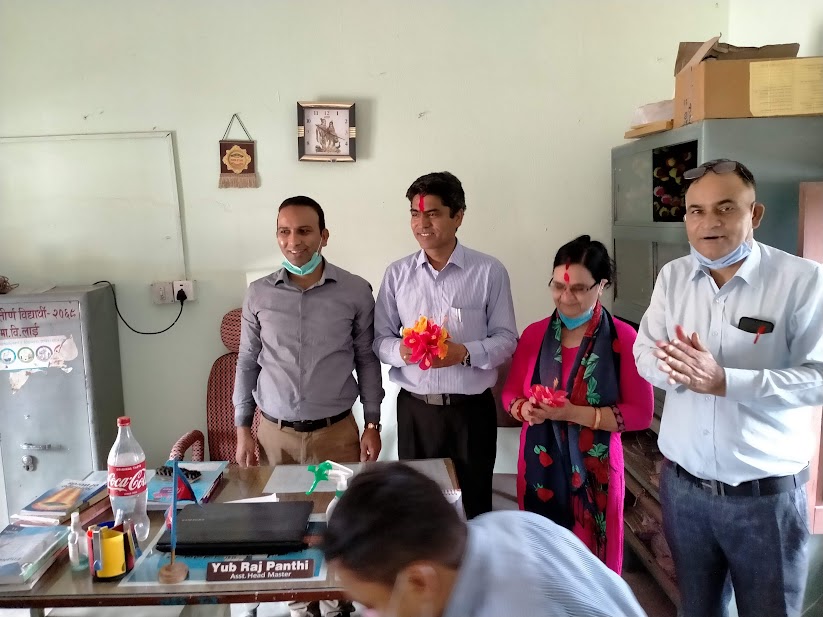
We conduct differnt programs and activities at school. I involved with other colleagues to such extra curricular activities at my work place.

Visiting different places makes refreshed. I like to visit different places to get entertainment in my ledgure time. It helps to develop internal tourise.

It is my responsibility to fulfil the task assigned by Nepal government and related authority. I involved in the election of the parliament of Nepal.
To find the document, click the following link.
https://drive.google.com/file/d/1co9UPYSqfKIXnJYInC_XZI2DyIlTKnBe/view?usp=sharing
Summary and analysis of the essay, "Then and Now: Finding My Voice"
THEN
AND NOW: FINDING MY VOICE
-Elaine
H. Kim, Korea (1961-)
Summary and Analysis
Elaine
H. Kim is a professor in the Department of Ethnic Studies at
the University of California in the USA. As a Korean-American writer,
she has expressed her childhood and educational experience in America. She has
analysed how gender, race, and economic class make an impact on personal life.
In
her autobiographical writing “Then and Now: Finding My Voice”,
Elaine H. Kim presents her turmoil (a violent disturbance) and personal teenage
experience as a Korean refugee child in the USA during the decade of 1950s and
1960s. She expresses the painful suffering that she had undergone in the USA
during the post-conflict situation of Korea and its people in the USA.
The
writer loved fortune-telling, and she visited many fortune tellers and shamans (priest-doctors)
in Korea. It was suggested that her destiny would bring success and happiness
to a man. But a disaster for women: she would be a better wife or a mother.
Some women's fortune tellers predict that she must have a lot of fun in her
life. One amateur (unprofessional) fortune teller said that whatever shaped her
goals and ideas happened to her between the ages of 12 and 17. She thought it
was wrong because that was the unhappiest and most difficult period in her
life.
Kim
writes that she had to go through the problem of language and culture in a new
situation in the USA. As a Korean, culturally, she had to speak the Korean
language and live with Korean culture at home, even within America. By
contrast, she had to speak English at her school in the US. Living in a
bi-cultural situation was a really painful experience for the writer.
She
further expresses how her Korean identity was ignored in her school and how she
was being called “JAP” or “CHICK”. Likewise, Elaine also unravels the other
bitter experiences that she faced during her school years. She was othered and
discriminated against amongst her friends and in American society as well, just
for not being a US citizen.
During
the Korean War of 1950, many refugees filled her house. It was very difficult
for her parents to manage food and shelter for them. Their bedrooms were packed
with many beds. When she was a teenager, she faced other problems. There was a
cultural difference inside and outside her house. People inside her house spoke
Korean, ate Korean food, and talked about what was going on in Korea. But
outside her house, no one knew much about Korea. Most people thought that Korea
was a state in Japan or China. Her father said that the printing press and
gunpowder had been invented in Korea and that a Korean marathon
runner had won a gold medal in the 1936 Olympics. However, the writer was
taught at the school that the greatest inventions were made by European and
Americans.
The
writer also cites other examples where her family was discriminated against in
American society. She writes how her brother was bitten in public places just
because of being Korean. In later days, even though she knew how to speak good
English, she was not given equal status. She was always treated as a foreigner.
So, she committed to becoming a cheerleader in her American school, thinking
that she could get recognition and equal status as her American friends.
In this regard, Elaine was always eager to assimilate herself into
American culture, keeping her interest in the English language and culture.
Even though she tried hard to maintain her identity, she was always treated as a
foreigner and othered in America.
The
writer finally acknowledges that the social discrimination and
marginalisation she faced in her teenage years in the US became the source of
inspiration for her life and showed the path of her understanding of US history
and discrimination, the voice of women, and how Koreans suffered during the
1950s.
Arranging a Marriage in India
-Serena Nanda, the
USA
Summary
based on the points:
1.
Arranged
marriage is a deeply established social institution:
Nanda begins by explaining that
arranged marriage is extremely common in India, including among educated, urban
middle-class families. Marriage is therefore treated as a concern of both the
individual and the family. The existence of the term “love match” for a
non-arranged marriage shows how culturally established arranged marriage is.
2.
Marriage
is viewed as a family matter, not merely an individual choice:
In the essay, parents actively
search for a suitable partner for their children. The decision is therefore
embedded in family relationships and responsibilities. Nanda contrasts this
with her American understanding that choosing a marriage partner is primarily
an individual's decision.
3.
The
bride and groom may know very little about each other before marriage:
Nanda observes that prospective
couples sometimes do not meet before the marriage. If they do meet, their
meeting may be only a short conversation after the families have already
considered the match suitable. This initially seems strange to Nanda because
she associates marriage with personal knowledge and romantic love.
4.
Sita
represents an educated Indian woman's acceptance of arranged marriage:
One of Nanda's most important
examples is Sita, a college graduate with a degree in political science.
Despite being educated, Sita has accepted her parents' role in choosing her
husband. This challenges Nanda's initial assumption that educated young Indians
would necessarily reject arranged marriage.
Sita's reasoning is central to the
essay. She argues that marriage is too important to be entrusted entirely to an
inexperienced young person. Her parents know families, social relationships,
and backgrounds better than she does.
5.
Arranged
marriage reduces the pressure of finding a partner:
Sita gives another interesting
argument: young Indian women can concentrate on enjoying their lives rather
than constantly worrying about finding someone to marry. In her view, parents
undertake the search while the young person is relatively free from that
responsibility.
6.
Parents
investigate the prospective family's background:
The selection process is not
presented as completely random. Sita explains that her parents would
investigate the prospective husband's family background and verify the
information they receive. The family therefore functions almost like an
informal source of social and personal reference.
7.
Family
reputation is an important criterion:
Nanda later participates in the
search for a suitable bride for her friend's son. One prospective girl comes
from a family with an excellent reputation. Nevertheless, the match is
eventually rejected for another reason. This demonstrates that family reputation
is important but not sufficient by itself.
8.
Caste
and social status influence the selection process:
The essay shows that families
consider social and caste compatibility. For example, one prospective bride's
family belongs to a slightly higher subcaste than Nanda's friend's family. This
detail illustrates how social hierarchy can enter into the process of selecting
a marriage partner.
9.
Education
can paradoxically become a disadvantage:
One of the most striking examples
concerns the well-educated girl whom Nanda initially considers an excellent
candidate. She is attractive, educated, and from a respected family, yet the
family rejects her because she is considered “too educated.” This reveals the
tension between modern education and traditional expectations about women's
behaviour.
10.
Female
behaviour is judged according to traditional expectations:
The girl's rejection becomes
particularly revealing when a male relative sees her travelling around the city
alone and considers her “forward.” The incident demonstrates that a woman's
independence can be interpreted negatively when it conflicts with traditional
expectations of feminine behaviour.
11.
Nanda
initially judges Indian marriage through an American cultural framework:
As an American woman, Nanda
initially finds arranged marriage oppressive and difficult to understand
because she strongly values romantic love and individual choice. Her reaction
is important because the essay is fundamentally about cross-cultural understanding.
12.
Cultural
values shape people's understanding of freedom:
The essay raises a sophisticated
question: What counts as freedom? Nanda initially sees parental involvement as
a restriction on individual freedom. Sita, however, sees parental involvement
as guidance and relief from the burden of choosing a husband herself. Thus, the
same practice can have different meanings in different cultures.
At the deepest level, the essay
asks readers not to judge another culture exclusively through the standards of
their own culture. Nanda begins with strong objections to arranged marriage,
but conversations with Sita and her own experience as a matchmaker force her to
reconsider her assumptions. The essay therefore becomes an anthropological
exploration of how family, culture, individual choice, social status, gender
expectations, and marriage are interconnected.
A Sound of Thunder
- Ray Bradbury, USA (1920- 2012)
Main Characters:
ü Eckels
(Protagonist)
ü Travis
(the safari leader)
ü Lesperance
(Travis's assistant)
ü Billings
(hunter)
ü Kramer
(hunter)
ü Time
Safari Inc.
Summary and Analysis:
“A Sound of Thunder” uses time travel to explore
the consequences of human actions. The story is set in the year 2055, in which
a company, Time Safari, Inc., offers opportunities to hunt prehistoric prey.
Their advertising reads: “You name the animal. We take you there. You shoot
it.”
The story begins as the protagonist, Eckels, stands
nervously before a desk, paying ten thousand dollars for a trip. He asks if the
company can guarantee that he will come back alive, but the man behind the desk
answers that they guarantee nothing “except the dinosaurs.” He introduces the
guide, Travis, and explains that Travis has complete control, noting that there
are significant penalties for violating Travis’s instructions.
Eckels is excited by the time machine, and he holds an
unrelated conversation with the man behind the desk. In the recent presidential
election, Keith beat Deutscher, the latter of whom, the two men agree, would
have created a dictatorship. The man tells Eckels that people asked if they
could use time travel to escape if Deutscher had won.
The conversation continues, and the man behind the
desk warns that the dinosaurs are hungry, telling Eckels that he has time to
tear up his check. Angered, Eckels asks if he is trying to frighten him, and
the man says he is. He says that six guides and a dozen hunters died in the
previous year.
Eckels refuses to give up, and the man turns him over
to Mr. Travis. They head to the machine, put on their helmets, and hold their
rifles. The group comprises Travis, his assistant Lesperance, two other
hunters, and Eckels.
Travis explains how to kill a dinosaur, and they
arrive in the past. They learn that the company selects animals that are about
to die naturally. They can shoot these animals because their deaths would not
disrupt the timeline. Lesperance has already marked these animals with red
paint for easy identification.
Travis explains that they must stay on the assigned
track, a metal path hovering above the ground, so that no one accidentally
steps on any organism. Any accidental death, even that of a blade of grass or
that of a mouse, they are told, might trigger a chain of events that would have
disastrous effects on the future. The whole course of history might be altered.
Travis reveals that the “government doesn’t like us
here” and admits that the company paid large bribes to operate. After a
discussion of whether the theory about time necessarily holds true, he tells
the hunters to get up; it is time for the hunt.
Eckels is excited and waves his gun a bit too
carelessly. Travis orders him to be more careful. As they approach the
Tyrannosaurus, he tells Eckels to take the first shot. Amazed at the lush,
primeval jungle, Eckels’s confidence increases until he sees the animal. Its
size sends him into a state of panic, and he flees, accidentally stepping off
the track. In the chaos and noise, the Tyrannosaurus charges the group. They
manage to shoot and kill it. After its death, the other hunters vomit, and all
are terrified.
Enraged, Travis discovers Eckels hiding in the time
machine. He wants to abandon Eckels in the past, in part because of the
financial damage the company will face when they report what happened, but
Lesperance talks him into allowing Eckels to return. Travis orders Eckels to
retrieve the bullets from the carcass. The group travels to the present.
On return, Eckels and Travis notice a subtle change in
the environment. The same man sits behind the desk, but something differs about
him. They cannot identify what. Eckels notices that the sign now says: “Yu naim
the animall. Wee taek yu thair. Yu shoot itt.” Horrified, he frantically
searches the mud stuck to his shoes. He discovers a dead butterfly.
He cannot believe his eyes. He tries to convince
himself that the death of a butterfly could not have resulted in significant
change, but he asks the man behind the desk about the election. The dictatorial
Deutscher has won. Eckels wails loudly. He hears the sound of Travis’s breath
and Travis releasing his rifle’s safety. Travis raises the weapon, and the
story ends with “a sound of thunder.”
GAIA
-Shreedhar Lohani, Nepal (1944)
Summary
and Analysis:
In
this poem, ‘Gaia’ means the earth. The title of the poem comes from a Greek
myth. In Greek myth, Gaia (also called Gaea) is considered to be the Goddess of
the Earth. Hence, Gaia is the symbol or personification of Mother Earth or
nature. The poem was composed by Nepali poet Shreedhar Lohani. He is a popular
writer, critic, and poet. Lohani has presented Earth not as dead space but
as a human being who contains both good and bad qualities. This poem has
only 12 lines in two stanzas.
Gaia herself is the source of power, beauty, and kindness, exactly like a
mother. That's why she manages to balance even the devouring rain and the
searing wind among the withered palm trees. The sea, with its vast and foamy
mouth, has the capacity to swallow everything, yet Gaia exists to oversee all
these natural elements specifically for human beings.
Though
nature is a goddess, she is surrounded by threats and challenges. The poet
shows that the earth, or Gaia, is in pain. But she is capable of taking care of
herself and enduring everything. The earth is gentle: feminine, nurturing, but
also cruel to those who exploit her. To show how death lives in all parts
of the earth, the poet has used many images of death. Lohani begins with the image of wind, which is surging (Rise or move forward), very hot wind, which has made the entire
palm tree wither (lose freshness/ fade) away. He writes that the rain, which is
generally supposed to be the source of life, is in fact devouring (destroying
completely) life itself. The poet most probably is referring to the floods
that occur time and again and sweep away human settlements by the image of
devouring rain. The world is described as a house that has been covered by
hunger from all sides. Then, the second-to-last line of the poem contradicts all destructive qualities of earth with another quality because the
earth tolerates all these obstacles (challenges, threats, and difficulties)
because she knows that there is no creation without destruction. Hence, Earth
alone can show the best way to live life. That is, we should not be afraid of
the difficulties of our life because they might have occurred to sharpen us so that
we can do our best in our life.
Gaia
has an appeal for the protection and preservation of the environment. She has been functioning as a mother to all
the creatures in general on the earth and also for human beings in particular.
Despite countless mistakes from human beings, Gaia, the mother earth, has not
become frustrated but is still taking care of us in the way she can. However,
there must be a limit to her endurance; one day, she could become quite
dangerous to us due to her equally devastating nature. She has the capacity to
devour the rain. Her condition is like that of a woman who can be quite hostile
(aggressive) if angry, but still, she remains quiet, kind, and loving, caring
for us due to her natural traits of saving others' lives. The poem speaks about
the ecological issue vividly, and the earth itself is a representative of the
female. That is why the poem has a strong ecofeminist tone.
HOW SANE ARE WE?
Anuradha
Chaudhary,
Bangladesh
(1947-)
Main points
of the essay:
1. 20% of the greenhouse effect is caused by CFCS.
2. Human beings lack rationality in their thoughts and behaviors.
They are irresponsible, and they don’t care about nature and ecological issues.
3. Chlorofluorocarbons (CFCs) are very harmful man-made chemicals
that affect the ozone layer and cause the greenhouse effect.
4. The ozone layer is made up of oxygen atoms and blocks 99% of the
sun’s ultraviolet (UV) rays and protects life on Earth.
5. If the ozone layer depletes, it will very badly affect the
Ecosystem, agricultural production will decrease, and people will suffer from
skin cancer and eye cataracts.
6. Developed countries have banned the use of CFCs to control ozone
layer depletion.
7. Science fiction has also warned people of the harmful effects
due to the destruction of the Ecosystem and the ozone layer.
Summary
and Analysis:
The
Essay "How Sane Are We?" by Anuradha Chaudhary is based on the
environmental problem. She is a professor of environmental biology. In this
essay, as a researcher of the environment, she talks about the degrading
condition of nature and its surroundings. Basically, she presents her ideas
that human beings have been too irresponsible and indifferent to the
conservation of the environment, and she predicts that it will make their life
quite difficult. She believes that due to human indifference, rapid urbanization,
and industrialization, the environment is getting heavily polluted. Mainly, she believes that the gases produced
by the industry, mishandling of the chemicals, and the excessive use of CFCs (chlorofluorocarbons)
have greatly contributed to the destruction of the ozone layer, which
causes skin cancer, the greenhouse effect, and other various epidemics.
Similarly, people have been greatly suffering from various natural
calamities such as floods, but still, people don't seem concerned about the
direction of their preservation. Finally, she believes that if it continues, it
will be impossible to continue living on it.
We
are made to believe that man is a rational animal. We believe that human
beings, hence, act rationally. This is only a constructed myth. The various
facts at the present time tell how important it is to preserve the biosphere
for human beings’ survival, but when the time comes to act rationally, we
behave most irrationally. Chaudhary’s essay cites one example, which is the way
we are interfering with the Ozone layer with the massive production of
Chlorofluorocarbons.
Ozone
stops the harmful ultraviolet radiation from outer space from getting down to
us, and it thus acts as a natural shield to protect living beings on Earth. If
this shield is destroyed, life may disappear from the planet. Chaudhary writes
that chlorofluorocarbons (CFCs) cause a 20% greenhouse effect, which is capable
of completely destroying life on Earth. Chaudhary also mentions that the ozone
layer protects our lives by absorbing 99% of ultraviolet rays. If it reaches the
earth, she believes more than 240 million people will get skin cancer, and
eight million might get eye cataracts, which would result in millions of deaths.
Chaudhary appreciates the decision of some developed countries like the United
States, Canada, Sweden, and Norway to have banned the use of CFCs in
aerosol (a dispenser that holds a substance under pressure and that can
release it as a fine spray) sprays.
Chaudhary’s
essay, therefore, explores an important flaw in human nature. She strikes at
the root of humankind’s problem and traces it to our greed, lethargy, and above
all, irrationality.
Why Go to University
Moti Nissani, USA
(1947 -)
Main points of the essay:
1.
Career and income:
The
better qualified someone is, the better their job prospects and income tend to
be.
2.
Practical value of knowledge:
Education
sharpens judgment and reduces superstition, making educated people harder to
deceive or take advantage of.
3.
Better health:
Educated
people tend to pay more attention to physical exercise and overall well-being.
4.
Power exercise/ problem solving:
Reasoning,
tolerance, humility, and reflection help educated people work through conflicts
and difficulties more rationally.
5.
Greater social respect:
Educated
people tend to be more respected in society, while a lack of education can hurt
someone's standing and self-confidence.
6.
A wider social world/
Inquisitiveness:
University
expands a person's social circle, exposes them to new ideas, and increases
their sense of personal freedom.
7.
Less dogmatism and superstition/
Expand the horizon:
It
makes people less rigid about their own beliefs and more tolerant of others',
loosening the grip of prejudice. Similarly, you can meet new people, visit new
places, and expand your social horizon.
8.
A clearer picture of how the world
works:
Educated
people have a more scientific understanding of the universe, for instance,
knowing that the Earth moves rather than the Sun.
9.
Support for democracy:
An
educated public is better able to judge policymakers and their policies, which
is what keeps democracy functioning properly.
10. Personal
growth:
Altogether,
it builds self-confidence and contributes to a more well-rounded, meaningful
life.
Summary:
In his essay "Why Go
To University," Moti Nissani discusses the importance of a university
education. Generally speaking, universities are where we receive higher
education. An individual's wealth for a healthy existence is knowledge, which
allows one to realize one's freedom, rights, and justice. A man who has
received an education or knowledge is simply regarded as being prestigious in
society.
Since education is a path
to happiness, attending university might add more stress to our lives.
According to Nissani, a university degree offers the chance for a fulfilling
career as well as work options and revenue sources. Because education makes
individuals more accepting, humble, intelligent, critical, funny, and less
superstitious, uneducated people are more likely to be fooled. Due to the ease
with which educated people can solve problems, they are also more likely to
lead meaningful lives.
Because it teaches
students that a sound mind depends on a sound body, higher education encourages
people to strike a balance between their physical and financial well-being. It
gives us the opportunity to broaden our social horizons by enabling us to interact
with individuals from across the world and aiding in our understanding of
politics, culture, religion, and many other aspects of the global community. In
summary, a university education improves our knowledge of who we are and the
environment in which we live. Overall, the author focuses on the advantages of university education.
A 1996 Commencement Speech
-Salman
Rushdie
About the Author
Salman Rushdie (1947-) was born in India. He is a
British-Indian novelist and essayist. He is popularly known for his second
novel, "Midnight's Children (1981), and his fourth novel, "The
Satanic Verses (1988). His style is mostly based on magical realism and
historical reality. Most of his works are about diasporic, imaginary
homelands, connection, disruption, and migration between the people from the
East and the West. He is also one of the influential post-colonial critics.
Summary
Salman Rushdie, as an Indian writer, shares his bitter
experience with his students at Bard College, in the USA, during the Commencement
Speech on Graduation Day. Rushdie was invited to deliver the 1996
Commencement Speech at Bard College. Rushdie addresses the members of the class
of 1996. He criticizes himself and Cambridge University and shares his
bitter experience of his own Graduation Day of 1968 with his students, and also
regrets compromising with falsehood and injustice in the past
In 1968, Rushdie graduated from Cambridge University,
the year of great student protests. He was associated with the protest,
although he was not involved in the protest himself. Just a few days before
Graduation Day, some of his friends threw a bucketful of thick brown gravy and
onion sauce all over the walls, furniture, clothes, and recorder in the absence
of Rushdie.
Rushdie was accused of such work and declared to be
disqualified from the degree. The condition was that unless he submitted the
report of the incident, he would not be declared eligible for his degree. So, he
says, although Cambridge University prides itself on the tradition of fairness
and justice, it solely accused him of the mischief and made him pay up.
On Commencement Day, Rushdie went to the ceremony with
brown shoes, which were not allowed. He was immediately held and sent back to
alter his shoes. Rushdie altered his shoes and returned a few minutes later. He
decided to surrender in the face of injustice. Rushdie paid up for the damage and
compromised with injustice. Rushdie bowed his head to the feet of the
Vice-Chancellor.
There were no other options left for him. He followed
and did whatever they told him because the degree he was going to receive was
the product of his hard work. He accepted slavery and autocracy. In the end, he
achieved his B.A. Degree from Cambridge University.
In 1996, Rushdie, as a Commencement Speaker, addressed
the graduating students and shared all his experiences with them. He
tells them not to accommodate injustice and not to bow their head to have their
rights. He advises that they should not tolerate it if people accuse them of abuse
when they are innocent. He urges them to stand up and fight for their rights
and justice.
We have nothing good to learn from God. The men and
women have made the world. They have made it despite their gods. Human beings
have best expressed their humanity by going against the gods. The gods are
weakened by their show of strength, whereas human beings grow stronger even if
they are destroyed. Human beings can be happy, creative, competitive, and
loving, too. Finally, Rushdie suggests that "We human beings must not bow
our heads; rather, we must ignore the gods."
Selected Question-Answers from A 1996 Commencement Speech
Rushdie says that the Colleges of
Cambridge pride themselves on the "ancient tradition of fairness and
justice." Does he mean what he says or is he being sarcastic? Please
explain your answer.
Rushdie says that the Colleges of Cambridge pride
themselves on the ancient tradition of fairness and justice. In fact, he is
being sarcastic about the traditional system of college administration,
organizing commencement days, and distributing certificates. Rushdie had to pay
the college for somebody else's mistreatment in his room, so he was punished
for not wearing the right shoes and would be disqualified for the degree if he
had not accepted such injustice.
It is the truth that Rushdie credits his experiences
at Cambridge University more than he credits his degree in history. He says,
"Throughout my life, no one has ever asked me what kind of degree I got or
even if I've got one at all. I've to say it's been useless." Rushdie
regrets compromising with falsehood and injustice in the past. He supplicates, bowing his head to the fact of injustice just for achieving a B. A. Degree.
Therefore, he suggests his students never bow their heads before falsehood,
injustice, unfairness, slavery, and autocracy.
What does Rushdie mean when he says that
"Defiance is an inevitable and essential aspect of what we call
freedom?" Do you agree with him? Have you ever defied anyone? If so,
please recount that specific episode from your own life.
I partly agree with Rushdie on defiance as an
inevitable and essential aspect of what we call freedom. Freedom begins with an
act of defiance. We need defiance to enjoy our rights and freedom. We should
defy those who suppress us and force us to comply with injustice. We should
never bow our heads before falsehood, injustice, unfairness, slavery, and
autocracy. Similarly, we should defy God to create love, creativity, and
humanity.
On the other hand, defiance of all the orders, rules,
and regulations of the organization results in anarchy and chaos. Therefore, we
must respect and obey certain rules, laws, and systems that are for all common
people,
I have had a bitter experience in my life when I bowed
my head in front of injustice and the conservative system of the society when I
was studying at the +2 level. I had a good relationship and love with Susmita, my
classmate who was from a lower caste. As we were classmates, we used to go to and
return from college together. On holidays, I used to go to her house, where all
her family members used to love me a lot. I was so pleased with them. One day I
invited her to come to my house, but my family members and society ignored and
criticized our relationship. Later, I was forced to leave that college and join
another college just because of caste discrimination.
Despite his scathing criticisms of
Cambridge and himself, is Rushdie bitter or grateful for the education he
received at Cambridge? Please support your answer with specific passages from
the text.
During his Commencement Speech on the occasion of
Graduation Day at Bard College, the USA, in 1996, Rushdie expresses scathing
criticism of Cambridge Colleges and his own passivity in the face of unfairness and
injustice. He makes a bitter satire against the college run by the traditional
system, injustice, autocracy, and slavery. He inspires his students never to accept injustice and autocracy, but to fight for their own rights and
freedom
However, Rushdie is very much grateful for the
education he received from Cambridge University. He says, "Cambridge
University, where I was so happy for three marvelous years, and room which I
gained so much...." He says that we learn to be tolerant and open to new
ideas. The experiences he received from Cambridge University are more useful
and important. Finally, Rushdie appreciates his experiences more than his
Degree from Cambridge University in history.
SURELY YOU'RE JOKING, MR. FEYNMAN
-Feynman &
Leighton
Background of Richard Feyman:
Richard Feynman was born in 1918 and passed
away in 1988. He was a renowned American physicist celebrated for
his groundbreaking contributions to quantum mechanics, particularly the path
integral formulation and quantum electrodynamics, for which he was awarded the
Nobel Prize in Physics in 1965. His innovative use of Feynman diagrams provided
intuitive visual representations for complex subatomic interactions. Beyond his
theoretical work, Feynman was instrumental in the development of the atomic
bomb and played a key role in investigating the Space Shuttle Challenger
disaster. He was one of the
greatest theoretical physicists of the 20th century.
Main
Points of the Essay:
ü When Mr. Feynman committed a social error during a tea party
organized by the Dean of his college, then he learned to behave correctly
in a social gathering.
ü In the beginning, he used to sit only with groups of physics, but when he started sitting with a group of other
disciplines like zoology and biology he became the top student in the college.
ü This essay tries to say that a lot of fun, different kinds of
interests in different disciplines, and interdisciplinary approaches are the key
to successful learning. This essay recounts Feynman's life through his
childhood education. He appears confident, interesting, and inspiring. He
discovers that he is a great artist, musician, scientist, and critic, too.
ü The essay talks about the importance of a sociocultural
environment that directly influences learning.
ü People who are talented and genuine can adjust to any corner of
the world by exploring and using their knowledge.
ü The essay suggests that if we work hard and understand the value
of time, we will achieve the destination of our life.
Summary:
"Surely You're Joking, Mr. Feynman"
is Richard Feynman's autobiography. It is based on the writer's experience with
his college education regarding knowledge and methods. The title of the essay
itself captures the point Feynman is trying to make about life and education.
The writer claims that knowledge must be based on scientific methods and that it
must be gained through an interdisciplinary approach. This essay tries to show
that the traditional method of learning is baseless and misleading.
Furthermore, a talented and genuine man can adjust anywhere in the world.
Interest is the most important motivation in education, and what and how one learns
can be measured.
Richard P. Feynman was a Physics student
who completed his undergraduate from MIT, America. He loved his
institution so much that he wanted to graduate from there.
However, Prof. Slater did not accept his enrolment because Feynman
had to find out what and how the rest of the world was going and doing. So,
according to the suggestion of Prof Slater, he decided to go to Princeton
College for graduation.
He went to Princeton College with his father
by car. He also got a room there. He stayed in the hostel with his friends. The
college looked like an imitation of Oxford University and Cambridge
University. One day, the Dean of Princeton College, Prof. Eisenhart, organised
a Tea Party to welcome the new students. Feynman was not very familiar with the
culture and manners of such social gatherings. He got confused about how to
behave and where to sit. Mr. Feynman was asked if he liked cream or lemon tea.
But he replied that he would like both. Listening to his reply, all the people
started laughing. At the same time, Mrs Eisenhart commented, “Surely,
you are joking, Mr. Feynman!”
Gradually, Feynman learned the manners of
social gatherings at Princeton College. Then, he started going to the tea party
and dinner parties as well. In the very beginning, he used to sit in the
physics students’ group, but later he started sitting with groups of
biologists, zoologists, and philosophers. Mr. Feynman became a talented and
genuine student among the college students. He understood the importance of an
interdisciplinary approach in learning. So, he realized why Princeton College
was right for him.
He started to take part in philosophical
discussions and sometimes in biological groups, as well as physics classes. He
spent lots of time on biological work. He also did research on a phase and
discovered the double mutation process. His discovery made him popular among
biology students. Later, he was invited to Harvard University to give a lecture
on biology. Despite his hard work and discovery of new things in biology, he
could not be satisfied. Though he knew and did a lot about biology and other
subjects, his actual interest was in physics. So, he expected to go back
to physics sooner.
Mr. Feynman had many opportunities to gain
knowledge in different disciplines during his graduation from Princeton
College. He got a golden opportunity to observe a cyclotron (An
accelerator that imparts energies of several million electron volts to rapidly
moving particles) and how it works. He was also invited to conduct a
seminar on Biology by Prof. Watson at Harvard
University. So, he gave a lecture to the Biology students at Harvard
University. Although Mr Feynman was a physics student, he learned a lot of
things and gained experience in Biology. He loves physics more, but equally, he
prefers to gain knowledge from different disciplines.
TV CAN BE A GOOD PARENT
-Ariel
Gore, USA (1970)
Summary
ü In
TV Can Be a Good Parent, Ariel Gore responds to guidelines from the American
Academy of Pediatrics (AAP), which recommend that children under two, and
especially babies and toddlers, should avoid television because it may harm
their brain development and impede healthy social, emotional, and cognitive
growth.
ü Gore
admits that in an ideal world, direct interaction between parents (or
caregivers) and children is best.
ü But
she argues that for many parents, especially single mothers, poor working
mothers, or those without enough support, the recommendation to avoid TV is
unrealistic and ignores their difficult circumstances.
ü Drawing
from her own life, she explains that when she was a child, there was no TV; childcare
was communal, neighbours and friends helped each other, and rent was low. But
now social and economic conditions have changed: she has to work to survive,
rents are high, and there’s no community support.
ü In
such a context, television sometimes becomes the only “co-parent” possible. On
days when she is away or overwhelmed, she lets her child watch educational or
children’s programmes (for example, shows similar to “Big Bird” or “Barney the
Dinosaur”), rather than leaving a child unsupervised. She claims that TV, when
used responsibly, can occupy some parenting roles and give her the breathing
space she needs to manage life.
ü However,
Gore does not unconditionally support the TV: she criticizes violent or
mindless programming. She argues that what matters is which TV programmes
children watch, and under what circumstances, not simply a blanket ban on TV.
ü Moreover,
she links the debate to larger systemic issues: lack of living-wage jobs,
insufficient welfare or childcare support, the high cost of rent, and the
disappearance of communal child-care networks, all of which make a strict
“no-TV” rule unrealistic and unfair to disadvantaged families.
ü In
short: Gore doesn’t claim TV is perfect. Rather, she contends that for certain
parents under social and economic pressure, TV can serve as a practical and
better-than-nothing co-parent, especially when there is no alternative
childcare support.
In Nepal, many families (especially in urban or
semi-urban areas) struggle with economic hardship, migration (parents going
abroad), nuclear families, etc. As a result, some children grow up with limited
supervision or attention. The question “Is TV always harmful?” might be too
rigid. Perhaps, as Gore suggests, what kind of content children watch, and how
often, matters more than a blanket ban.
Critical Analysis:
I find Gore’s argument valuable and humane because she
draws attention to structural inequality, economic pressure, and social
realities, often ignored in “idealistic” parenting advice. Her personal
experience gives weight to the idea that for many working or single mothers, TV
is not just entertainment but a coping mechanism, a companion, a substitute
when nothing else is available.
However, I also believe that ideals should remain
ideal: children, especially in their formative years, need real people:
parents, caregivers, community, peer play, and conversation. Media and TV
should be considered a support, not a replacement. The goal should be to reduce
reliance on TV through social change: better wages, community support networks,
accessible childcare, etc.
Comprehension Questions (Short Answers)
1. What does the American Academy of
Pediatrics recommend regarding TV for young children?
Answer: The AAP recommends that children, especially
those under two years, should avoid watching television because it may harm
early brain and social development. TV is not a substitute for real
parent-child interaction.
2. Why does Gore believe the "no-TV
rule" is unrealistic for many parents?
Answer: Gore argues it is unrealistic because many
parents, especially single and low-income working mothers, lack community
support, affordable housing, and sufficient childcare. TV becomes a practical
co-parent when no one else is available.
3. What kind of TV programmes does Gore
approve for children?
Answer: She approves educational and child-friendly
shows that teach values, use gentle language, and help learning and
imagination. She rejects violent, shallow, or meaningless programmes.
4. How does Gore compare her childhood
parenting environment to her daughter's?
Answer: Gore grew up without TV but with strong
community care, low rent, and shared parenting support. Her daughter grows up
in a costly, isolated, and busy world where parents must work, and community
support is rare; hence, TV fills the gap.
5. According to Gore, what should be
questioned more: TV itself or the content of TV?
Answer: She believes the content and context of
watching TV should be questioned, not television itself. Responsible and
selective use matters more than prohibition.
Critical Thinking Questions (Long Answer
Questions):
6. Do you agree with the title “TV can be
a good parent”? Give reasons.
Answer: I partially agree. Gore uses the term “good
parent” metaphorically to mean that TV can act as a support system, not a
biological parent. In real life, TV sometimes keeps children safely engaged
when parents are overwhelmed or working. Educational shows can foster language
learning, moral values, and curiosity.
However, TV cannot replace personal care, emotional
bonding, conversation, or social learning that children gain from active human
interaction. Therefore, TV can be a helper, temporary guardian, or co-parent,
but not a complete parent. The main idea is that support systems for working
parents must improve so TV doesn’t become the only option.
7. How does the essay highlight the
relationship between parenting and socioeconomic conditions?
Answer: The essay shifts the responsibility from
individual parents to society. Gore shows that:
· Many
parents work long hours due to financial pressure.
· High
rent and low wages reduce time for children.
· Communal
childcare systems that once supported families have declined.
Because of these conditions, parents may rely on
television. So, the essay suggests parenting decisions cannot be judged equally
for everyone; economic realities directly shape childhood experiences. The
essay becomes a critique of inequality, modern isolation, and lack of
institutional support for parents.
8. What is the central message of Ariel
Gore’s essay?
Answer: The central message is that:
Ø Ideal
parenting is human interaction, but society does not provide ideal conditions
for all.
Ø TV
can serve as a practical parenting aid when used selectively and responsibly.
Ø We
should not shame parents for using TV, but instead improve jobs, childcare
support, and community care systems.
Ø The
debate should focus on what children watch and why, not simply on banning TV.
9. What are the major arguments for and
against children watching TV based on the essay?
Answer:
|
For TV |
Against TV |
|
Helps parents
manage life when exhausted or working |
Can’t provide
real emotional care |
|
Educational
shows can teach language, values, and learning |
Violence and
shallow content harm children |
|
Keeps children
away from danger when no caregiver is present |
Overuse may
affect cognitive growth |
|
Can act as a
temporary "co-parent." |
May reduce real
social interaction |
The essay concludes that TV is not the enemy;
irresponsible content and the absence of support systems are the real issues.
10. How can TV be used responsibly for
children? Suggest any 4 ways.
Answer: TV can be used responsibly by:
Ø Selecting
age-appropriate educational content
Ø Setting
fixed time limits for watching
Ø Watching
together and discussing the lessons/messages
Ø Avoiding
violent or meaningless programmes
Ø Balancing
TV with outdoor play, reading, conversation, and family activities
11. Write a short paragraph explaining the
essay's relevance in the context of Nepal.
Answer: In Nepal, over time, the child-rearing culture has changed. In the past, children were raised in
joint families where parents and grandparents used to have time to look after
the children. But in the later days, many parents work long hours or migrate
abroad for employment, leaving children with limited supervision. In urban and
semi-urban areas, rising costs and nuclear family structures reduce family
support. Hence, the idea that TV can act as a supportive guardian is relevant
here, too. However, unlike some Western settings, many Nepali communities still
share childcare informally, so TV should be a support, not a replacement. This
lesson encourages parents and students to view media use through a lens of
social reality, empathy, and responsible selection, rather than strict judgment.