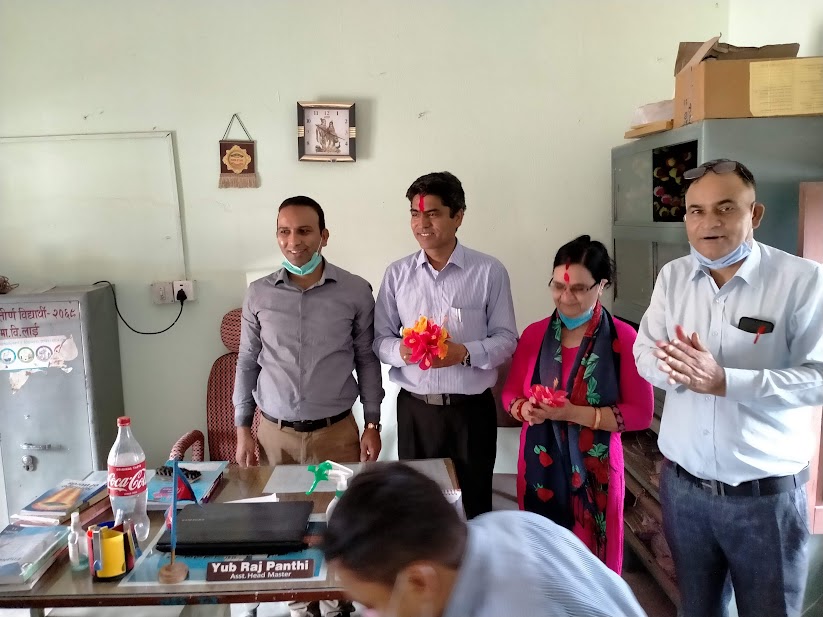
• Celebrating Holi Festival at home in Butwal.

    Celebrating festivals is a part of preserving culture. It makes us strong and helps to transfer the culture and tradition to the generation. I celebrated the festivel with my kids and wife at home in Butwal, Nepal.

  • Working at school with colleagues

    We conduct differnt programs and activities at school. I involved with other colleagues to such extra curricular activities at my work place.

  • Visiting new places for research and entertainment

    Visiting different places makes refreshed. I like to visit different places to get entertainment in my ledgure time. It helps to develop internal tourise.

  • Taking part at General Election 2017.

    It is my responsibility to fulfil the task assigned by Nepal government and related authority. I involved in the election of the parliament of Nepal.

Showing posts with label Grade 11. Show all posts

Class: 11, English : The Sunny Morning, Summary and Questin answers

You- tube video of The Sunny Morning. 

The Sunny Morning, Summary and Questin answers 

About the Play

‘A Sunny Morning’ is a light comedy that recounts the reunion of two lovers now in their 70s meeting at a park. In their youth, they were ardent(devoted) lovers but torn apart by the cruelty of fate. The setting of the play is a sunny morning in Madrid, on a bench in the park.

Characters

1. Dona Laura

2. Petra, Laura's Maid

3. Don Gonzalo

4. Juanito, Gonzalo's Servant

Summary

In a sunny autumn morning, Dona Laura, a handsome, white-haired old lady of about seventy enters the corner of a park in Madrid with the help of her maid Petra. Her mental faculties appear to be fine. She sends Petra to chat with her lover. She feeds the pigeons with the breadcrumbs. At the same time, Don Gonzalo a gentleman of seventy, also enters the park with his servant Juanito. He sits at the end of bench with the old lady. Laura is angry. She says that he should have asked her permission before sitting on the bench.


They become friends after sharing snuff together. They find something in common that they sneeze alternately three times each. Then, they talk about their hometown. Gonzalo says that he is from Valencia (city in Spain). To his surprise, Laura reveals that she lived in a villa at Maricela near Valencia. They realize that once they were in love but decide to hide the fact. He tells Laura that he knows a girl named Laura Llorente who lived in the villa and was the most beautiful woman he has ever seen. Laura tells him that the woman was her best friend. He remembers his cousin, who was her lover.


Gonzalo admires her beauty. Laura adds that her friend was unlucky and had a sad love affair. The lover used to pass by on horseback every morning through the rose garden and throw a bouquet of flowers to her balcony which she caught. In the afternoon, the lover would return through the same way, and catch the bouquet of flowers she would toss him. But her parents wanted her to marry a merchant whom she disliked. Then, there was a duel (battel/ fight) between the lover and the merchant at sunrise on the beach. The merchant was badly wounded. The lover fled to Seville and then to Madrid. He tried to communicate with Laura through letters, but all his attempts failed. After that, he joined the army and went to Africa. He died there with the flag of Spain in his hands and whispering the name of Laura.


Laura tells him that her friend waited for days, months, a year and no letter came. She, without finding the lover, went to the sea shore, wrote her lover’s name on the sand and sat upon a rock. The tides rose to the rock and swept her out to sea. In reality, after three months Gonzalo suddenly ran off to Paris with a ballet dancer. On the other hand, Laura got married two years later. They do not unveil who they really are. They leave the park promising to meet the next day.


Understanding the text

a. What makes Dona Laura think that Don Gonzalo is an ill-natured man? Why do neither Dona Laura nor Don Gonzalo reveal their true identities?

Gonzalo scares away the birds who are feeding on her bread crumbs. He makes immoral comments on the priests. He talks to Laura very rudely. This unfriendly behavior makes Laura think he is an ill- natured man.

Laura and Gonzalo can’t regain their youthful romance now. They think that it is disrespectful to share the fact and denounce their true love. Furthermore, they fear of losing the pleasant interaction after the revelation of the truth. So, they don’t reveal their true identities.

b. At what point of time, do you think, Laura and Gonzalo begin to recognize each other?

Gonzalo says that he is from Valencia and Laura reveals that she lived in a villa at Maricela near Valencia. At this point, they begin to recognize each other.

c. When does Dona Laura realize that Don Gonzalo was her former lover?

After they share their memory of the hometown, Gonzalo tells her about the Silver Maiden and describes her beauty. At this time, Dona Laura realizes that Don Gonzalo is her former lover.

d. Why do Dona Laura and Don Gonzalo spin fictitious stories about themselves?

They spin fictitious stories about themselves because they think that it’s not good to disclose the identities at old age, and they want to spend their remaining life with sweet memories.

e. How do Dona Laura and Don Gonzalo feel about each other?

During their conversation, they find that they were lovers once in their youthful days. But they are not ready to disclose their identity. They have no hatred and are ready to depart. They promise to meet the next day. Laura sees Gonzalo picking up the violet dropped by her. Both of them bid farewell.`

Reference to the context

g. What is the effect of flashback in the play when Dona Laura and Don Gonzalo knew that they were the lovers in the past?

The flashback helps Laura and Gonzalo to realize that they were lovers in their youth. However, they pretend to be true to each other. They narrate false stories to fool each other. They think that revealing the fact can make them lose their present happiness. At the end of the play, they depart promising each other to meet the next day.

h. Discuss how the play is built around humour and irony.

Humor is carried in the opening scene of the play. The comic sense of Laura is admirable when she remarks on Gonzalo’s walking. She says “A carriage would not raise more dust than his feet.” Her utterance creates laughter when she asks Gonzalo if he uses his handkerchief as a shoe brush.

The references to the location and sequence of events and their association clearly hint that Gonzalo and Laura were once lovers. It is ironical that they do not want to reveal their identities, as they fear that their changed looks can be restraints in their newly found happiness.

i. How is the title ‘A Sunny Morning’ justifiable? Discuss.

Dona Laura and Don Gonzalo loved each other but circumstances separated them. They used to be active, romantic and lively which suits the atmosphere of sunny morning. But, they are inactive now. The wonderful memory of their youthful days make them forget their age and think that it is a sunny morning. Thus, the title ‘A Sunny Morning’ is justifiable for the play.
 

What is Poverty? by Jo Goodin Parker Summary and Question Answers: (Grade: XI, English)


What is Poverty? 

                     -Jo Goodin Parker 

Summary and Question Answers:

Summary:

The essay ‘What is Poverty?’ written by Jo Goodwin Parker. It is a realistic essay in which she gives a real account of what poverty actually means. She describes how painful it is to live amidst in poverty and her daily struggles to raise a family.

Parker stresses that poverty is uglier, crueler and more devastating than it is shown in newspapers. She defines poverty as a lack. It is living without hope, better foods, health care, proper sanitation and proper education. It is compared to an acid that destroys pride, honor, health and future. Her main idea is to show how humiliating and disgusting it is being poor. In the essay the evidence of her daily struggle is mentioned very clearly. She wants to draw the readers' attention to the pathetic condition of poor people. The poor are forced to live a restless life looking at the dark future of their children. Poverty ruins the family relationship.

After giving birth to the last baby the essayist divorced with her husband because he was jobless. Once the children were left under the care of their grandmother. She found her children in a miserable condition when she got back home. She was unable to admit her children at a nursery school because of her insufficient income. She made 20 dollars a week and a nursery school cost 20 dollars a week for three children. Therefore, she left her job.

Parker is successful in evoking sympathy from the readers. She makes the readers realize how depressing poverty is. She shows us that there is no hope for the poor without understanding them.


Understanding the text

Answer the following questions.

a. What is poverty according to Parker?

According to Parker, poverty is being dirty, smelly, and with no proper underwear on and with the stench of the rotting teeth.

b. How is poverty difficult for Parker’s children? List some specific examples.

- Once she left her children with their grandmother. She found her children in a miserable condition.

- For breakfast her children are fed grits with no oleo or cornbread without eggs and oleo.

- To buy a jar of Vaseline for the baby’s diaper rash the essayist had to save money for 2 months.

- In winter, children are in danger of being burnt as newspapers on the wall are likely to get caught by a spark, and in summer they are covered with when they cry.

- Children are always with runny noses.

- They have no extra books, no magazines, no extra pencils, or crayons, or paper and most important of all, they are not healthy.

c. How does Parker try to obtain help, and what problems does she encounter?

She asks her relative for a loan. She is supposed to visit the office. She circles the building four or five times. She goes in. Everyone is very busy. Finally, someone comes out and asks her if she needs help. That isn’t the person she needs to see. She goes to see another person. After telling him the whole story about her poverty she finds that this is the wrong office. Then, she must repeat the whole process.

d. Why are people’s opinions and prejudices her greatest obstacles?

She is stricken hard by poverty. She is unable to raise her family well. She divorced with her husband. She is ill- treated while asking for help. This makes her lose her pride and honor and ultimately shatters her dream.

e. How does Parker defend her inability to get help? How does she discount the usual solutions society has for poverty (e.g., welfare, education, and health clinics)?

According to Parker the usual solutions society has for poverty are far from her access. There is a surplus commodities program which cost too much. A school lunch program can’t benefit her children as her children whose health will be worsened by the time they go to school. Health clinics are in the towns. She lives out here eight miles from town. Everything has a cost.


REFERENCE TO THE CONTEXT

a. Explain the following:

 Poverty is looking into a black future.

Answer:

This line " Poverty is looking into a black future" has been stated by the writer Jo Goodwin Parker in her essay. She has put forward this line for her readers to present her experience related to poverty. Here in this line, the writer is advising all the readers about an ugly and cruel aspect of poverty. According to her, poverty leads people towards the black future. Poor people have to live miserable life daily. It is quite difficult to manage proper daily foodstuffs for them. For them, there is no hope for the upcoming future. They keep on spending their lives in disparity looking into a black future. Poverty breaks expectations and dreams of future days.

b. What does Parker mean by “The poor are always silent”?

Answer:

By "The poor are always silent", Parker means the helpless state of poor people. In poverty, money plays a very vital role. Money itself is the right solution for all the problems. But, due to lack of money, poor people feel weaker. They always remain silent in front of others. They have to listen to others words being silent due to their pathetic state.

c. What writing strategy does the author use at the beginning of most of the paragraphs? Do you notice a recurring pattern? What is it?

Answer:

Here in this essay, the author uses her repetition strategy at the beginning of most of the paragraphs. Yes, I notice a recurring pattern. It is the structure " Poverty is". The essay is well organized, and the structure “Poverty is” is repeated at the beginning of each paragraph.

Here, with the help of her repetition strategy, she tries to establish a relationship between the woman and the readers. The author's informal style makes the writing appear as part of a casual conversation between the narrator and the readers. Goodwin Parker’s writing is extremely effective and reaches its purpose.

d. How does Parker develop each paragraph? What details make each paragraph memorable?

Answer:

Parker develops each paragraph starting with her repetition strategy. She starts most of her paragraphs with a repetition statement as "Poverty is". Later, she provides her personal experiences about her topic sentences. 

The author first clearly explains to her readers that her purpose is to help people understand what poverty is. Her second purpose is to convince all her readers to help people in need. The details related to her personal painful experiences and the bitter reality of poverty make each paragraph memorable.

e. In the final paragraph, how does the author use questions to involve the readers in the issue of poverty?

Answer:

In the final paragraph, the author uses questions in her informal style of direct conversation to involve the readers in the issue of poverty.

Parker has done a successful job at involving her readers through her persuasive manner. She asks them to look at the poor with an angry heart but not with a pitiable heart. This manner of question has attracted readers' emotions as well as attention. Here, in the final paragraph, she has become successful to attract her readers' attention toward her plight and the struggles of other's in her situation.


REFERENCE BEYOND THE TEXT

a. Define a social problem (homelessness, unemployment, racism) imitating Parker’s style.

Answer:

Homelessness is sleeping in footpaths. Homelessness compels you to sleep in footpaths. Living life on footpaths makes you weaker in various aspects. It ends up your pride and prestige.

Unemployment is living a life with shame. Unemployment degrades your value in society. Due to the lack of a job, you feel shame and humiliation all the time. People ridicule you in the name of unemployment.

Racism is living a life with humiliation. The racists make you feel weaker in society. They keep on humiliating you in the matter of skin colour. Due to your skin colour, you will have to face humiliation in your society. Living life under the concept of racism is a curse.


b. Using adjectives to highlight the futility of the situation, write a short definition essay on Growing up in Poverty.

Answers:

Poverty is defined as a pitiable situation where people feel a lack of various essential things in their life. Apart from others' opinions, I think growing up in poverty is annoying. Poverty never allows you to be happy. Living life in poverty annoys you most of the time. Growing up in poverty makes your life boring. You never try to do anything interesting living within the criteria of poverty. You feel both confusing and disappointing to grow up in poverty. You feel confused about your life all the time. Disparity and inequality never let you be free and do something good in your lives. Growing up in poverty is a frightening experience where you have to face various hardships and struggles. It provides you with a tiring and worrying experience where pains are always ready to welcome you.


Grade: XI, English (Poem: All The World's a Stage)

 Grade: XI, English (New Course), Poem: All the World's a Stage "Exercises"


Understanding the text

Answer the following questions.

a. Why does the poet compare the world with a stage?

·        The poet compares the world to a stage because he considers all men and women like the actors of a drama. These actors perform their different roles here in this stage and leave this worldly stage one day.

b. What is the first stage in a human's life? In what sense can it be a troubling stage?

·        The first stage in a human's life is the stage of infanthood. It can be a troubling stage in the sense that this stage is a fully dependent stage where the infant is fully under the care of the mother. The infant can cry and even vomit anytime in mother's arms.

c. Describe the second stage of life based on the poem.

·        The second stage of life is the stage of boyhood. In this stage, the boy is a school going, student. He slings his bag over his shoulder with his shining face and creeps to school unwillingly like a snail.

d. Why is the last stage called second childhood?

·        The last stage is called second childhood because here in this stage the man loses his senses of sight, hearing, smell and taste. He acts like a child and finally exits from the roles of his life.

e. In what sense are we the players in the world stage?

·        We are the players in the world stage in the sense that we perform different roles here in this world stage. We play seven different roles in our entire lifetime and finally depart from this world stage.

 Reference to the context 

a. Explain the following lines:

All the world's a stage,

And all the men and women merely players

·        Here in these lines, the poet has compared the whole world with a stage where men and women are only players (actors). After birth, they perform their many roles here in this worldly stage and finally, leave this stage moving towards their final destination (death).

b. Explain the following lines briefly with reference to the context.

They have their exits and their entrances; 

And one man in his time plays many parts,

·        These beautiful lines have been taken from William Shakespeare's realistic poem "All the World's a Stage". These lines are the parts of Jacues's monologue. Here, the poet has said that the people in the world have their entrances (birth) and exits (death). People arrive here in this worldly stage through birth and leave this stage through death. A man here in this worldly stage has to perform many roles in his lifetime and leave the stage after his death.

c. Read the given lines and answer the questions that follow.

Then the whining schoolboy, with his satchel

And shining morning face, creeping like snail

Unwillingly to school.

i. Which stage of life is being referred to here by the poet?

·        The childhood stage of life is being referred to here by the poet.

ii. Which figure of speech has been employed in the second line?

·        In the second line, simile, a figure of speech has been employed where the boy has been compared with snail using like.

iii. Who is compared to the snail?

·        The school-going boy is compared to the snail.

iv. Does the boy go to the school willingly?

·        No, the boy doesn't go to the school willingly. His unwillingness can easily be the motion of snail towards his school.

d. Simile and metaphor are the two major poetic devices used in this poem. Explain citing examples of each.

·        Here in this poem, we find major poetic devices as simile and metaphor. The poet has used these poetic devices a lot. The examples of simile and metaphor of this poem are as follows:

a) "All the world's a stage" - Metaphor

b) "And all the men and women merely players" - Metaphor

c) "And shining morning face, creeping like a snail" - Simile

d) "Full of strange oaths, and bearded like the pard," - Simile

e) "Seeking the bubble reputation" - Metaphor

f) "His youthful hose, well sav'd, a world too wide" - Metaphor.

g) "and his big manly voice, Turning again toward childish treble" - Metaphor.


e. Which style does the poet use to express his emotions about how he thinks that the world is a stage and all the people living in it are mere players?

·        The poet uses a narrative style to express his innermost emotions about how he thinks that the world is a stage and all the people living in it are mere players or characters. These characters go through seven different phases in their lives. He has explained the real aspects of human life for all readers to understand the reality of life.

f. What is the theme of this poem?

·        The theme of this poem is that person is the ultimate loser in the game of life. A person makes an entry in this worldly stage and performs different roles in his lifetime. Finally, he/she leaves this worldly stage struggling in different circumstances. He/She comes empty-handed here and leaves this stage empty-handed. He/She brings nothing and takes nothing.


Reference beyond the text 

a. Describe the various stages of human life picturised in the poem "All the world's a stage."

·        According to Shakespeare, the world is a stage and everyone is a player. He says that every man has seven stages during his lifetime. He performs different seven roles in his lifetime and finally exits from this worldly stage. The first stage of a man is childhood. He plays in the arms of his mother. He often vomits and cries in this stage. In his second stage, the man is an unwilling school going, student. He becomes a lover in his third stage. He is very busy composing ballads for his beloved and yearns for her attention. In the fourth stage, he is aggressive and ambitious. He seeks reputation in all what he does. He is ready to guard his country and becomes a soldier. In his fifth stage, he becomes a fair judge with maturity and wisdom. In the sixth stage, he is seen with loose pantaloons and spectacles. His manly voice changes into a childish treble. The last stage of all is his second childhood. Slowly, he loses his faculties of sight, hearing, smell and taste and exits from the roles of his life. Thus, Shakespeare has presented the pictures of the seven stages of a man's life in the poem 'All the World's a Stage'. 

b. Is Shakespeare's comparison of human's life with a drama stage apt? How?

·        Yes, Shakespeare's comparison of a human's life with a drama stage apt. He compares the whole world with a stage where men and women are only actors. In a drama, every player enters the stage, acts his/her part and then exits. In the same way, we enter this world by birth. We lead our life in different characters. We exit from this world at the time of our death. Shakespeare says that every man has seven stages during his lifetime. His opinion related to life is quite right. Players or people come into this worldly stage and perform their seven different roles and finally part away from this stage. Our life is divided into seven different stages and in these stages, we keep on performing different roles seeking various things in our life as actors. Here in this worldly stage, we play the role of an infant, a boy, a lover, a soldier, a judge, an old man and an extremely old man. So, human life is a drama.


Advertisement